
Lake Nakuru National Park
- On June 16, 2014
- By victoria
- In Africa, Kenya
 0
We visited Lake Nakuru National Park, which is 5km south of Nakuru, Kenya’s fourth largest city and the capital of the Rift Valley Province.
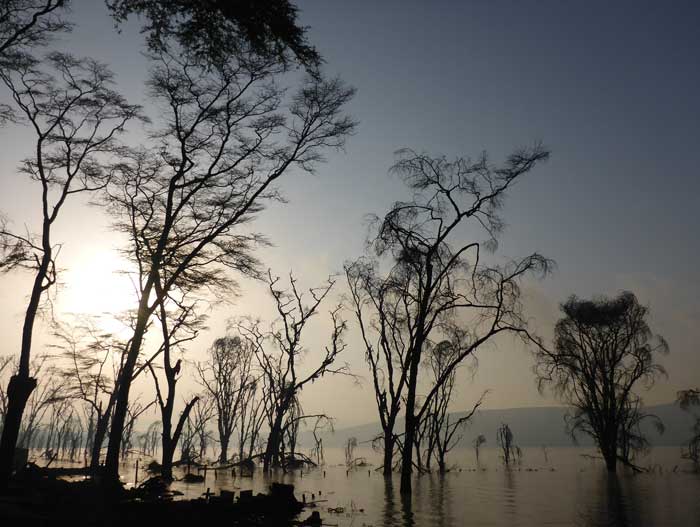
Just inside the main gate you pass the previous main gate which is now flooded, along with the original office block. The long rains in 2012 raised the level of the lake considerably and due to the fact that Lake Nakuru has no outlet, the level hasn’t decreased much since. This has also had an effect on the number of Greater and Lesser Flamingos in the park. There were once 2 million Lesser Flamingos, but the increase in water level lowered the salinity and the flamingos began to disperse.
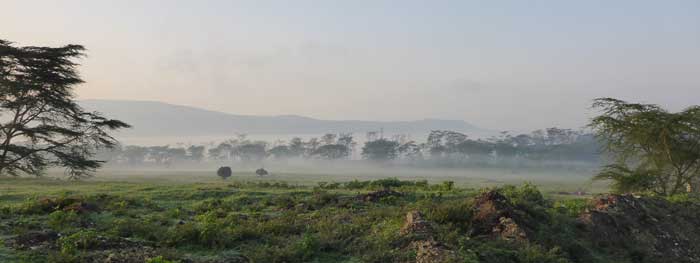
Traveling in a matatu with a roof that raised up so we could stand inside and look out the roof, we got into the park just after sunrise, the mist was still lying heavily on the lake, making for some lovely scenery. We were only in the park 5 minutes and we saw a Lioness and her cub feeding of a caracas! The park is 188 square kilometres and one of Kenya Wildlife Services premiere parks, the other being Amboseli.
The landscape of the park is mostly acacia forest, with open areas, escarpments and cliffs. I saw a lot of reddish brown acacia trees, which looked like they had died. Our guide told us this is due to the floods, acacia trees have shallow roots and if they take on too much water they can’t cope and it kills them.
Hoping to see my first Lion today! We were driving up to Baboon Cliff, I was leaning out the window scanning the bushes for animals. We turned a sharp corner and there he was, lying in the dusty ditch in the sunshine, a young male, about two years old. He had a lovely speckled face, his mane wasn’t fully grown yet, but he had huge eyes staring back at me! When we stopped to look at him he got up and moved into the bushes, but we managed to get a good view of him there. The view from Baboon Cliff looked out over the lake and you could see just how much has been flooded.
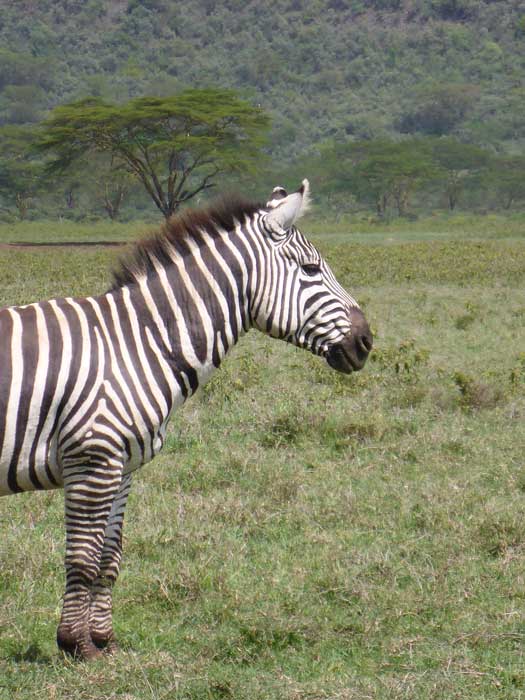
We drove on anti-clockwise round the lake. In the forested areas we saw lots of Baboons and some Vervet Monkeys and on the more open areas we saw herds of Rothschild Giraffe feeding on the acacia trees, quite a few of them had lain down, so all you saw was their neck and head high above the grass. There were lots of Planes Zebra and Buffalo on the open areas, and down by the waters edge there were Yellow Billed Pelicans, Flamingos and Buffalos lying in the water to cool off.
When we got back into the denser forest we saw three White Rhinos, two adults and a baby, grazing on the grass just beside the road. The White Rhino has a flatter snout than the Black Rhino, this makes it easier for them the graze the grass, the White Rhino is also more docile than the black and usually travels in a crush (herd). Later on in the afternoon we saw a lone Black Rhino on his own further in the bushes. The park has lost 25 black rhinos to poachers this year (2014) alone!





I grew up in Nyeri...not too far from Nanyuki. Fond memories. You've described Nanyuki pretty accurately. Glad you enjoyed your…
Hallo.i have reading now ur article. I live 9 years in Nanyuki and like this life and the ppl. Welcome…
Thank you! Glad you enjoyed it and found it useful. I enjoyed the few months I stayed in Nanyuki last…
Hey Mzungu lassie? Very informative info about Nanyuki and the surrounding areas. I've been there once (for a day) and…
Brilliant pics, You must sleep well, whizzing around on quad bikes up & down the dunes and sand boarding.